.svg)

Segmentation, which divides an image into multiple objects, has evolved into higher precision through deep learning technology.
There are various types of segmentation, such as semantic segmentation and instance segmentation. Instance segmentation is a technology capable of recognizing objects individually, realizing more advanced image recognition that was not possible with conventional segmentation.
In this article, we explain the overview of instance segmentation, its differences from other methods, and its advantages. We also introduce the methods and AI models used in instance segmentation, providing content that covers everything from the mechanism to the importance of annotation work.
For more details on image recognition, please refer to "What is image recognition? Types, mechanisms, AI development processes, case studies and key considerations.".
|
【Table of Contents】 |
1. What is Instance Segmentation?

Instance segmentation is an advanced image recognition technology that identifies individual objects contained in images or videos. It does not just roughly capture object positions by enclosing them in boxes like conventional object detection; it accurately captures the outlines of objects on a pixel-by-pixel basis, enabling more detailed analysis.
Furthermore, even when multiple objects belonging to the same class exist, they are identified individually and their respective shapes are separated, allowing for an accurate count.
Difference from Semantic Segmentation
Semantic segmentation, another major segmentation method, classifies all pixels in an image by class and recognizes objects belonging to the same class as a single group.
For example, if two dogs are pictured, both are recognized as one group called "dogs."
In contrast, instance segmentation identifies objects individually and accurately separates their respective outlines. In the same example, it is possible to recognize two dogs individually and capture their respective shapes.
Instance segmentation has advantages over semantic segmentation, especially in fields where precise data analysis focusing on individual objects is desired.
In "What is semantic segmentation? Explaining types, methods, and image processing application examples!", we explain semantic segmentation methods and use cases in detail.
Fields of Application for Instance Segmentation
Instance segmentation is applied and utilized as follows:
- Medical image analysis
- Autonomous driving
- Industrial robotics
- Agriculture
For example, in the medical field, it is used for image analysis when accurately identifying and separating organs or lesions from images such as CT or MRI scans.
In autonomous driving, it also plays a role in supporting safe driving by individually identifying pedestrians, vehicles, traffic lights, etc., on the road.
2. Advantages of Instance Segmentation
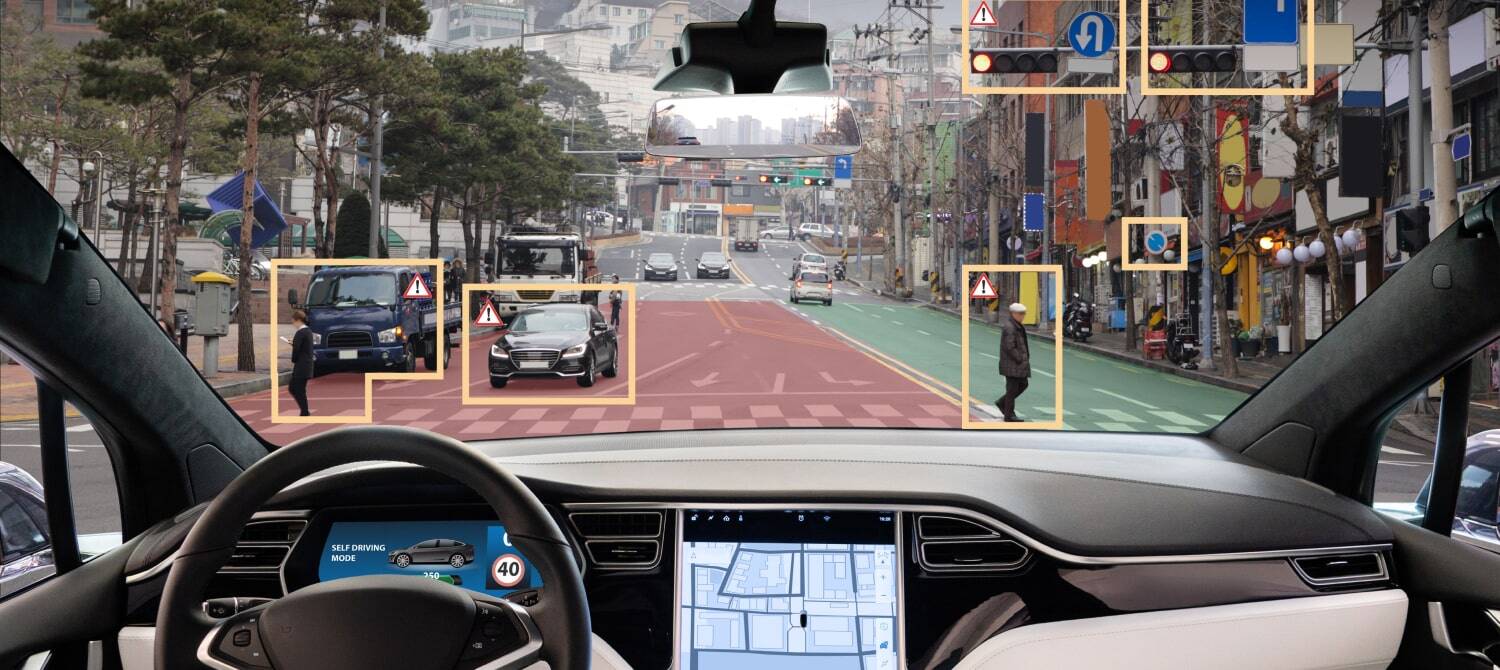
The advantages of utilizing instance segmentation include the following elements:
- Detection is possible even if objects overlap
- Detection of objects with complex shapes is possible
- Easy counting of object numbers
We will explain each of these.
High-Precision Object Detection and Separation
Instance segmentation allows for the precise separation of objects at the pixel level. This makes it possible to accurately identify and detect each object even if they are complexly overlapping in the image.
Since individual objects can be distinguished and analyzed even when multiple objects belonging to the same class exist, detailed data acquisition and advanced analysis become possible.
Acquisition of Detailed Shape Information
While bounding boxes simply enclose the outer frame of an object in a rectangle, instance segmentation accurately captures the outline of an object unit by unit in pixels. This makes it possible to analyze the exact shape even for complexly shaped or irregular objects, achieving precise data processing and analysis.
Easy Counting of Object Numbers
Instance segmentation makes it easy to count the number of objects. It is possible to accurately count the quantity or number of individuals even if objects of the same class present in the image are overlapping.
For example, it is effective in situations where accurate counting is required, such as traffic monitoring or object inspection on production lines, realizing efficient data collection and analysis.
3. Basic Methods of Instance Segmentation

Methods used for instance segmentation include the following:
- Convolutional Neural Networks (CNN)
- Transformer-based
- Region-based Convolutional Neural Networks (R-CNN)
- Fully Convolutional Networks (FCN)
- One-shot learning
Let's look at each method.
Convolutional Neural Networks (CNN)
Convolutional Neural Networks (CNN) are a method utilized as a fundamental technology in image processing. A CNN consists of convolutional layers, pooling layers, and fully connected layers, and it hierarchically learns local features in an image such as edges, textures, and shapes.
Region-based Convolutional Neural Networks (R-CNN)
Region-based Convolutional Neural Networks (R-CNN) are a widely used method in object detection and are one of the foundational methods for instance segmentation.
R-CNN extracts regions of interest from large-scale image data and applies CNN to each region to learn and classify object features.
Transformer-based
Transformer-based methods can learn relationships between pixels across a wide range by utilizing self-attention mechanisms.
The Transformer architecture analyzes input images by dividing them into patches. Because it directly learns interactions between pixels, segmentation accuracy improves even if the shape of the object is complex.
Fully Convolutional Networks (FCN)
Fully Convolutional Networks (FCN) are an architecture designed for semantic segmentation. To process the entire input image, all layers are composed of convolutional layers, and the output is similarly provided while maintaining its spatial structure.
It is difficult to distinguish individual object instances with FCN. Therefore, instance segmentation tasks require additional mechanisms or improvements, such as Mask R-CNN, while using FCN as a foundation.
One-shot learning
One-shot learning is a method for recognizing new classes by performing training using an extremely small amount of sample data, in some cases only one sample per class.
Because one-shot learning performs training efficiently with little data, it can be utilized in situations where data acquisition is difficult or labeling costs are high.
4. AI Models Used for Instance Segmentation

In instance segmentation, AI models utilizing the following methods are used:
- Mask R-CNN
- YOLACT
- PointRend
- DETR (DEtection TRansformer)
- Mask2Former
We will explain each of these.
Mask R-CNN
Mask R-CNN is a deep learning model that performs object detection and segmentation integrally. Built on Faster R-CNN, it simultaneously performs class classification, bounding box regression, and mask prediction within the object's bounding box.
YOLACT
YOLACT is an AI model characterized by a simple and efficient approach. By performing object detection and mask generation processes in parallel, it enables real-time segmentation and low computational costs.
YOLACT approaches with two elements: prototype masks and mask coefficients. It generates shared prototype masks for the entire image and multiplies them by the mask coefficients predicted for each object to generate the final mask.
PointRend
PointRend is a model that exhibits high performance for objects with complex shapes. It is an approach method that selects pixels to be regions of interest based on low-resolution prediction maps and performs high-resolution rendering for those pixels.
Through this, there is no need to process the whole in high resolution, and it is possible to perform accurate segmentation while using computational resources efficiently. It is especially effective for scenes where many objects with fine outlines or irregular shapes exist.
DETR (DEtection TRansformer)
DETR (DEtection TRansformer) is an advanced AI model that applies the Transformer architecture to object detection.
It uses a Convolutional Neural Network (CNN) to extract image features and predicts object position information and its class by inputting that feature map into the Transformer. Object detection is executed with high precision even in complex scenes.
Mask2Former
Mask2Former is an architecture that can unify the processing of three segmentation tasks: instance, semantic, and panoptic segmentation. It features a sophisticated mask attention mechanism and achieves high-precision segmentation for objects with complex scenes or shapes.
5. Annotation Work Points for Realizing High-Precision Instance Segmentation
-2.webp?width=1500&height=670&name=image%20(19)-2.webp)
To increase the precision of instance segmentation, annotation is necessary. The following points are key in annotation work:
- Selection of appropriate tools
- Skilled annotators
- Efficient workflow
We will explain each point.
Selection of appropriate tools
Selection of appropriate tools is important in annotation work for instance segmentation. By using an annotation tool suitable for the purpose, accurate and efficient annotation work becomes possible.
Annotation tools are equipped with many functions that support efficient segmentation, including detailed mask creation on a pixel-by-pixel basis and automatic completion functions for complexly shaped objects.
Through this, it is possible to handle complex datasets requiring accurate labeling and improve work efficiency.
For how to choose annotation tools, please also see Comparing 12 recommended annotation tools! Explaining what to look for and how to choose when you're unsure.
Skilled annotators
Skilled annotators are necessary for annotation work. In instance segmentation, annotation indicating accurate boundaries at the pixel level is required. Therefore, high levels of skill and concentration are demanded.
The skill and experience of annotators are especially tested when objects are overlapping or have irregular shapes. Skilled annotators are indispensable for improving the performance of instance segmentation models.
Efficient workflow
High-precision instance segmentation cannot be realized unless an efficient workflow is constructed.
It is necessary to clearly define the boundaries of objects in instance segmentation and specify how to handle overlapping objects. In particular, an iterative process of correcting and refining annotations based on the initial output results of the model becomes important.
6. Summary
In this article, we explained the advantages, methods, AI models, and points in annotation work for instance segmentation.
The quality of annotation work directly links to the precision of instance segmentation. Individuals or companies wanting to perform high-quality annotation should also consider requesting it from a company specializing in annotation.
Author

Latest Articles