.svg)
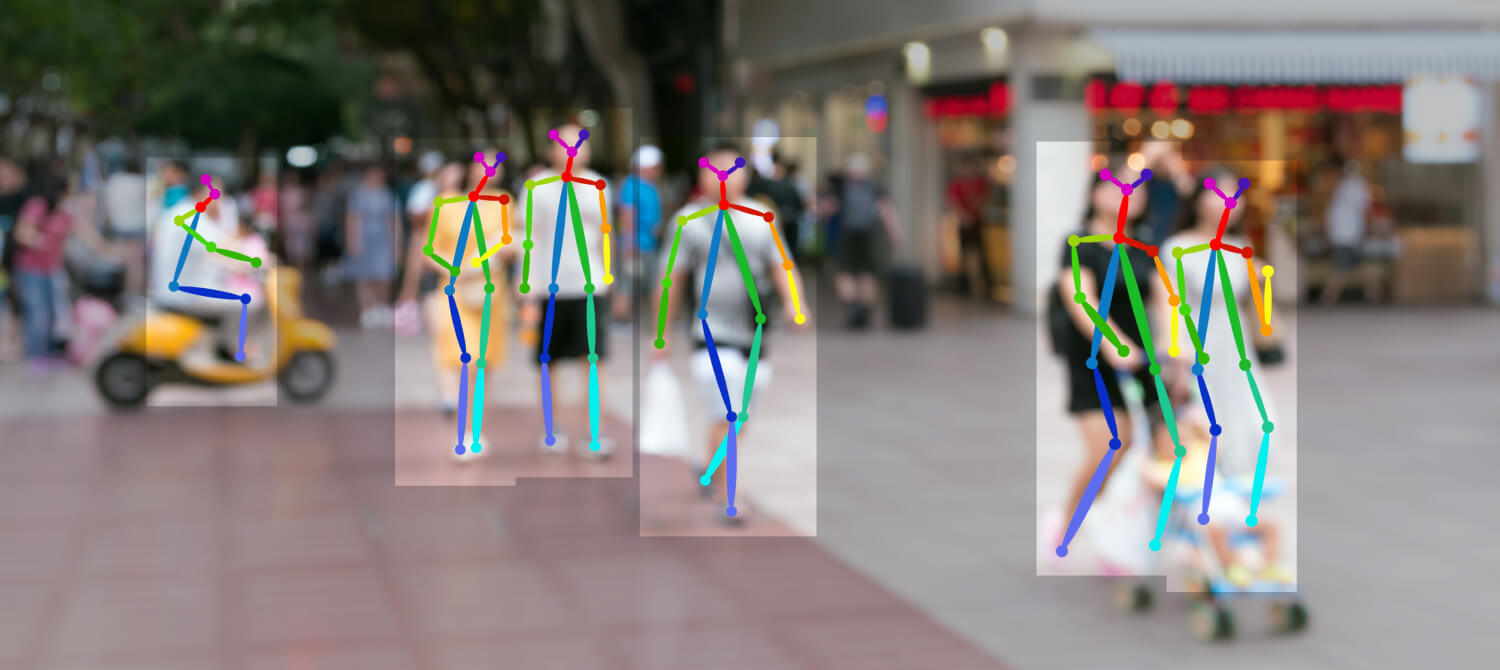
AI-based pose estimation has high precision and is utilized in various industries. On the other hand, because it is a state-of-the-art technology, many people may be troubled by the fact that they do not understand the mechanisms and procedures, making the implementation process difficult to see.
In this article, we explain the AI technology used in pose estimation, use cases, mechanisms, and the importance of keypoint annotation for achieving pose estimation. By reading this article, you will understand the mechanisms and usage of pose estimation and acquire basic knowledge toward implementation.
|
【Table of Contents】 |
1. What Is Pose Estimation?

Pose estimation is an AI technology that identifies the positions of skeletal structures and joints of humans and animals from data such as images and videos to analyze their posture. Posture estimation is possible by inputting images or videos into a deep learning model, which then predicts the position of each joint.
Regarding pose estimation technology, conventional mainstream methods relied on geometric estimation based on highly specialized data captured by sensors and markers. However, with the advancement of AI technology, it has become possible to accurately detect skeletons and analyze posture at a more advanced level even from data taken with cameras and smartphones.
AI-based pose estimation has excellent detection precision and is utilized in various scenes.
AI Technologies Used in Pose Estimation
Machine learning and deep learning technologies are utilized in pose estimation.
Machine learning is a technology that allows computers to learn from data and perform tasks without explicit programming. By extracting features from large-scale datasets and training models, the precision of pose estimation is improved.
Deep learning is a field of machine learning that uses multi-layered neural networks to learn complex patterns from accumulated data. By utilizing large amounts of data and high computational power, it performs advanced pattern recognition and significantly improves pose estimation precision.
In particular, Convolutional Neural Networks (CNNs), which have a structure inspired by the human visual system, automatically extract features from images and predict the positions of keypoints.
In addition, various other algorithms are utilized in pose estimation, and analysis precision is enhanced by combining multiple algorithms. Among them, the importance of AI technology is high and determines the precision of pose estimation.
Differences Between Bottom-up and Top-down Models
In pose estimation, there are two approach styles: bottom-up and top-down. While the goal of pose estimation is the same, the detection methods differ.
Both bottom-up and top-down models have their own advantages and disadvantages, so they must be used selectively according to the application and scene. When implementing pose estimation technology, select it based on the objective and the type of image or video data.
Bottom-up Model
Bottom-up pose estimation first detects all joint points (keypoints) from the entire image and then combines the detected points to construct the skeletal structures of individual persons.
Since bottom-up pose estimation detects all joint points in the image at once, it is possible to analyze effectively even in images where many people are present.
Therefore, it can perform analysis in scenes with many people or complex backgrounds while keeping processing time short, although there is a possibility that precision may be lower.
Top-down Model
On the other hand, top-down pose estimation is a method that first detects people in the image and then performs pose estimation for each individual. Since it first detects people and then estimates the joint points of each person, the precision of person detection significantly affects the overall precision.
Since pose estimation is performed for each person, the computational load tends to be higher compared to the bottom-up model, but it exhibits high precision and efficiency in pose estimation for a single person or a small number of people.
2. AI-Driven Pose Estimation Use Cases

Pose estimation, which is progressing in practical application, is utilized in fields such as the following:
|
We explain each use case.
1. Healthcare
In the healthcare field, pose estimation plays an important role and is particularly effective in the fields of rehabilitation and fitness. By analyzing patient movements in real-time and providing accurate feedback, it supports effective treatment and training.
It is also used for posture management during desk work or long hours of standing work, helping to prevent lower back pain and stiff shoulders. It can detect worsening posture and provide advice for improvement, making it an essential digital technology for maintaining health.
2. Sports
Pose estimation is also expanding its applications in the sports field. By being utilized for action analysis of athletes, it enables support for improving performance.
Specific methods of utilization include checking form during training and analyzing actions during competitions. It can also detect unnatural movements or excessive loads, playing an important role in injury prevention. Effective coaching is achieved by coaches and trainers checking the athlete's posture in real-time and providing immediate feedback.
3. Security
Pose estimation is attracting attention as a technology that also contributes to the security field. It is particularly compatible with cameras, and when combined with surveillance cameras, it can automatically detect persons acting suspiciously, enabling rapid response.
For example, it is used in systems that track the movements of people coming to event venues or stores and detect dangerous actions within specific areas. Additionally, because it can identify persons making suspicious movements even from within a crowd, it is utilized as a tool to prevent congestion and panic at live venues and sports facilities.
The combination of pose estimation and the security field improves crime deterrence and response capabilities for emergencies, helping to ensure safety.
4. Entertainment
Pose estimation is also bringing innovation to the entertainment industry. The technology is widely used in game and animation production.
Motion capture utilizing pose estimation technology accurately digitizes character movements and achieves realistic actions. Furthermore, in the fields of Virtual Reality (VR) and Augmented Reality (AR), reflecting user movements in real-time through pose estimation provides a more immersive experience.
By popularizing experiential entertainment that leverages pose estimation, new ways of enjoyment are provided to viewers and players.
5. Manufacturing and Logistics
Postures of workers in factories and warehouses are monitored with cameras equipped with pose estimation, and efficient and safe work is proposed and supported based on those actions. For example, it can detect inappropriate lifting actions or actions that place excessive load, helping to prevent industrial accidents.
It is also used for task automation and robot motion optimization, enabling the construction of efficient production lines. Improving work efficiency through such digital technology is effective in the manufacturing and logistics industries where labor shortages are becoming serious.
3. Steps to Start Pose Estimation

Pose estimation builds AI models according to the following steps. Here, we explain the flow for building a 2D pose estimation model.
|
We explain each step.
1. Data Collection
To perform AI-based pose estimation, it cannot start without data to be learned. First, images and videos capturing target actions are gathered. Public datasets or data filmed in-house are used. However, when using public datasets, please confirm in advance that there are no licensing issues.
To increase the precision of pose estimation, it is necessary to obtain high-quality data. For example, when collecting video data with a camera, clear videos can be filmed by adjusting the placement and lighting conditions.
Furthermore, to cover diverse actions and postures, data collection in different environments and situations is required. Instead of only data filmed from the same angle, it is possible to increase pose estimation precision by filming images and videos from multiple angles.
2. Selection of Annotation Tools
To perform pose estimation annotation work efficiently, it is important to select an annotation tool that fits the objective.
When selecting, consider the following points:
- Ease of use:
Select a tool that has an intuitive user interface and allows workers to perform annotation smoothly. - Fulfillment of functions:
Confirm that necessary functions are provided, such as placement of keypoints, recording of coordinate information, and collaborative work among multiple workers.
- Data format compatibility:
Select a tool that can output annotation results in a format suitable for AI model training. - Scalability:
Consider whether the tool can be expanded flexibly according to the project scale.
One of the representative annotation tools is COCO-Annotator. This is an open-source tool developed for the purpose of annotating the COCO dataset. Depending on the project requirements, other tools may be more suitable. It is important to select the optimal annotation tool by comprehensively considering the project objective, scale, budget, etc.
3. Definition of Keypoints
To achieve pose estimation, it is necessary to perform keypoint annotation.
Definition of keypoints is the task of defining the positions of the target's skeletal structure and joints. Generally, this includes the nose, eyes, shoulders, elbows, wrists, hips, knees, ankles, etc.
By labeling each joint point, the pose estimation model can recognize them more easily, enabling more advanced pose estimation.
Methods for placing keypoints and judgment criteria for ambiguous cases are also clarified.
4. Execution of Annotation Work
In annotation work, keypoints (joint points) defined in advance are accurately placed for each frame of the collected image or video data.
On an annotation tool, these keypoints are marked at appropriate positions on the image, and their coordinate information is recorded. To proceed with the work efficiently, it is important to set clear annotation standards and unify recognition among workers.
Once the points are set, skeletal structure and posture are estimated. AI algorithms such as Convolutional Neural Networks (CNNs) analyze the image and video data, detecting joint positions and the skeleton connecting them. Skeletal and posture estimation precision fluctuates depending on the amount of processed data and the richness of variations.
5. Output and Evaluation of Estimation Data
Once pose estimation annotation is complete, skeletal structures and posture information generated by the pose estimation model are visualized, and estimation precision is reviewed. Pose estimation data is output as results of estimating the posture of the person detected in the target data.
Quantitative indicators are used for the evaluation of estimation results, such as analyzing estimation results with mean error. By understanding model performance based on pose estimation results and finding improvement points as necessary, recognition precision can be enhanced.
4. Importance of Keypoint Annotation in Pose Estimation
Annotation is the task of attaching labels or marks to data and is an essential technology for AI models to learn accurately. Keypoint annotation plays an important role in pose estimation.
If annotation quality is low, the possibility of incorrect estimation results increases, so accurate annotation is required.
Keypoint Annotation for Achieving Pose Estimation
What is important for achieving pose estimation is keypoint annotation.
Keypoint annotation is the task of attaching labels to joints and characteristic points of humans and animals within an image and is an essential annotation for models to learn accurately. It is a method of specifying joint points such as shoulders, elbows, knees, and ankles.
Keypoint annotation is utilized in the basic mechanism of pose estimation. It is a flow where data subjected to keypoint annotation is utilized to estimate posture and skeletal structures based on it.
In this way, the fact that keypoint annotation is utilized as a mechanism of pose estimation also shows that annotation is important in pose estimation.
Annotation Is Indispensable for Improving AI Model Precision
You can see that annotation is indispensable for increasing the precision of pose estimation.
When high-quality annotation is provided, the model understands the accurate positions of joint points, and the precision in detecting different postures and actions improves. Conversely, if annotation is inaccurate, errors occur in the model's estimation results, and practicality is impaired.
Furthermore, performing high-quality and continuous annotation is important in model improvement. By reviewing annotation based on feedback from estimation results and updating the model's training data, recognition precision in pose estimation can be enhanced.
Internal Link
5. Summary
Pose estimation is utilized in various fields as a technology that can estimate person posture from images and videos. If you incorporate pose estimation technology into your company, it is necessary to deepen your understanding of annotation as well.
Without grasping the mechanism and importance of keypoint annotation, accurate pose estimation and model improvement cannot be achieved, and quality cannot be brought to a level sufficient for practical application.
Please proceed with the introduction of pose estimation technology after understanding the importance of annotation in pose estimation.
Author

Latest Articles